
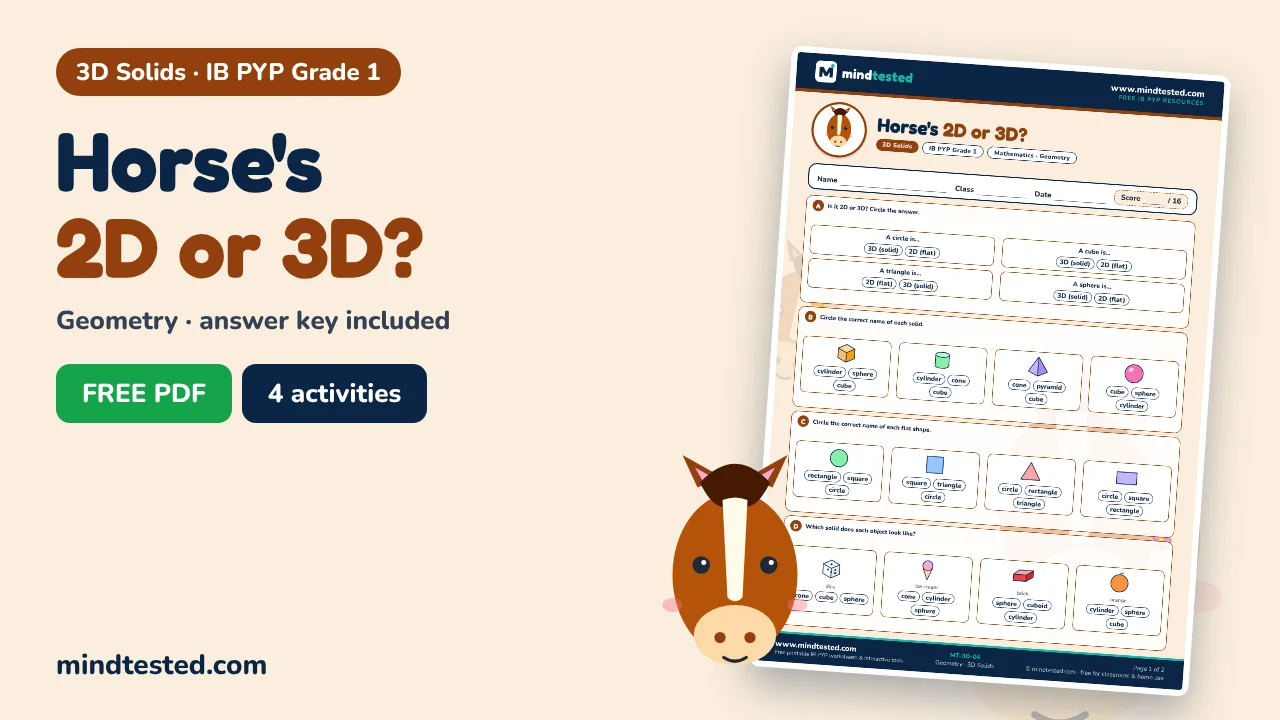
3D Solids in IB PYP Grade 1 Mathematics
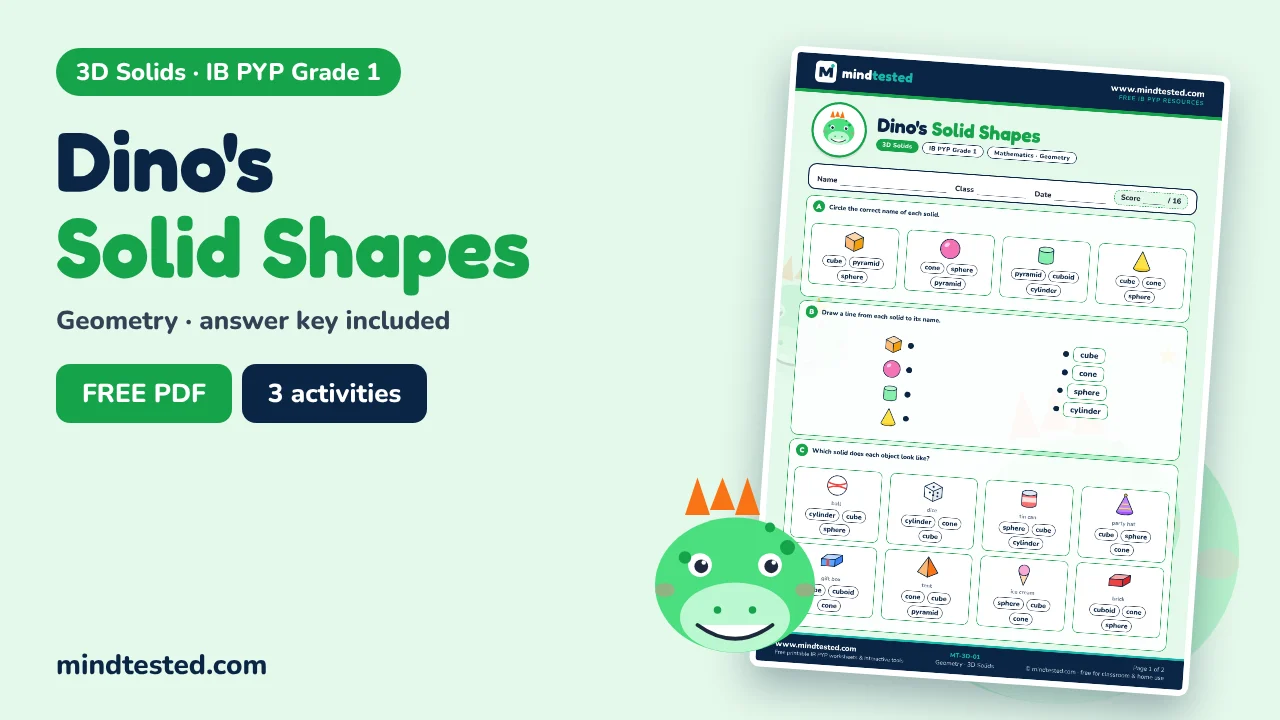
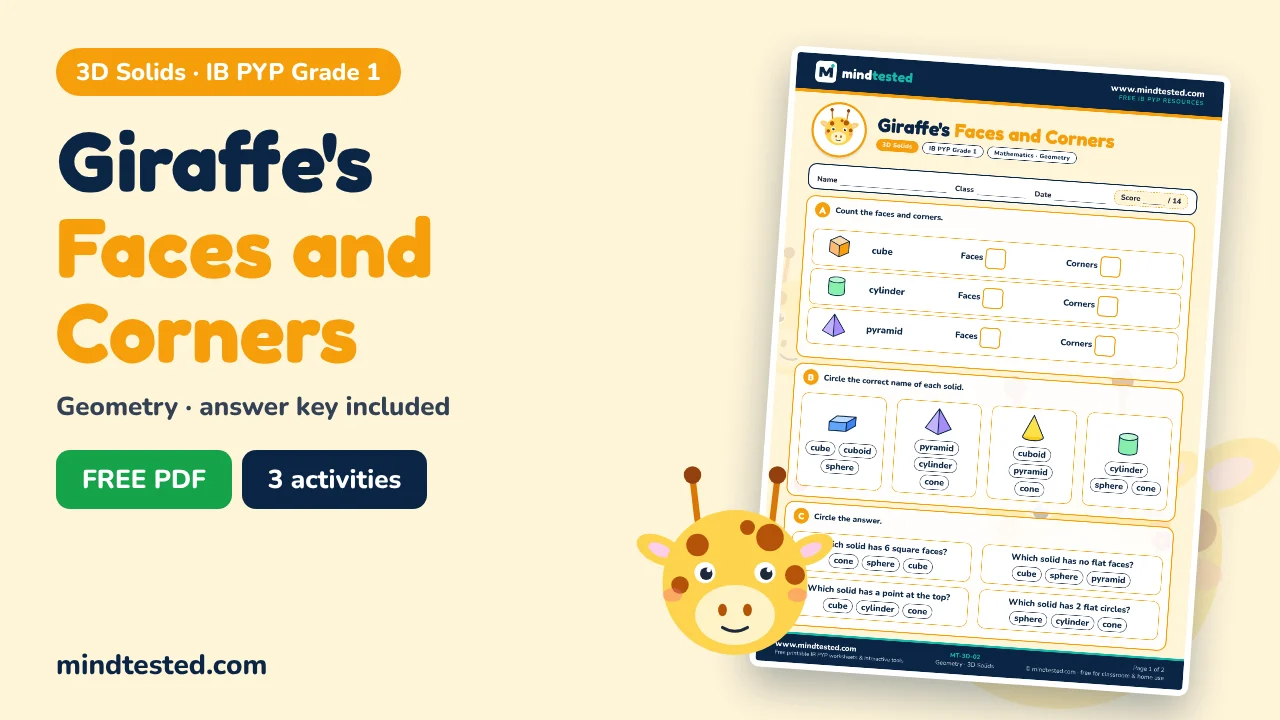
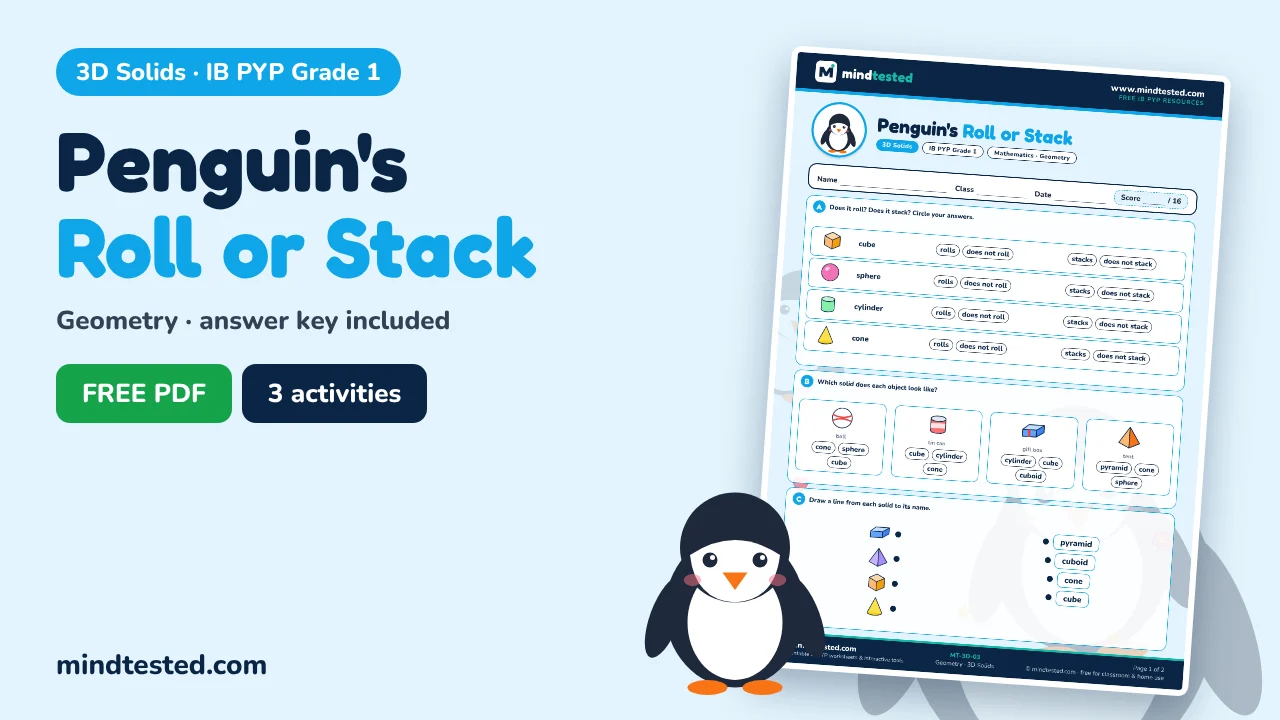
3D solids are shapes you can hold. Grade 1 learners name cubes, cuboids, spheres, cylinders, cones and pyramids, find them in real objects and talk about faces, corners and whether a solid rolls or stacks.
PYP learning is inquiry-based, so every worksheet here is short, colourful and playful, with a friendly animal guide and a teacher answer key on page 2.
What learners practise
- Naming cubes, spheres, cylinders and cones
- Finding solids in real objects
- Counting faces and corners
- Deciding which solids roll or stack
- Telling 2D shapes from 3D solids
3D solids at a glance
- Cube: 6 square faces, 8 corners
- Sphere: round like a ball, rolls
- Cylinder: 2 flat circles and a curved side
- Cone: 1 flat circle and a point
For students
Read each instruction carefully, try every question and colour the animal when you finish.
For parents
Print on A4, read the instructions aloud together and let your child work alone before you check.
For teachers
Use a worksheet as a starter, homework or exit ticket. Each one has a name, class and date box and an answer key.
Bring in tins, dice, balls and party hats. Let children roll and stack them to discover each solid’s properties.
Quick answers
Who is the 3D Solids page for?
It is for IB PYP Grade 1 Mathematics learners, typically aged 6–7, and for the parents and teachers who support them.
What is a face on a solid shape?
A face is one flat surface of a solid. A cube has six faces.
Which solids can roll?
Spheres, cylinders and cones can roll. Cubes and cuboids cannot.
How should I use these worksheets?
Pick one worksheet, let your child try it without help first, then check together with the answer key on page 2. Short sessions of five to ten minutes, a few times a week, work best.
Keep exploring
 Geometry
 2D Shapes
 Position and Direction